
Police Records Search
Arrests, Warrants, Mugshots, Criminal Records, Misdemeanors & More!
What customers are saying
"I called to cancel my account and the young man that helped me was very nice and helpful"
"The agent was wonderful. She explained everything to me in detail. Thank you!"
"Tom was able to look up my account and resolve my issue with great professionalism! Thank yoi"
"They were very helpful. Answered all my questions and solved my issue."
"Excellent customer service, I had my concerns addressed immediately without any problems."
"Great help, Patient and honest. My customer care was clear about everything."
"records were very clear and easy to search."
"The service was excellent handled everything I needed to be handled perfect i would recommend it"
"A top class act in customer service."
"I had been researching for a lost information on a vehicle for over a month. Ran into brick walls everywhere. Record Finder did the job for me. Thank you so much."
"The rep was very helpful and the information was great. Thanks"
"Exceptional customer service and outstanding site! I highly recommend!"
"They helped me find the information I needed."
"Excellent service with great ease of use. Very courteous and professional customer service as well."
"The lady who help me was very professional and helpful. She was able to find a solution to my issue I really appreciate her time."
"Customer service went the extra mile for me to correct a problem on my account and I am so very grateful."
"I worked with a wonderful woman named Rhea who was patient and understanding of my situation. If I am ever in need of your services again, I will not hesitate to use them."
"I am confident that Records Finder will be able to provide contact info on a missing person I wish to contact. I have used Records Finder several times in the past and usually with success. I recommend their services."
"I used Record Finder to find info on me. I really understand how important good info can be."
"The process was simple and straight forward. Accurate base on history and informative. Customer service representative was courteous and friendly."
"I had no problem with Record Finder and they helped me find the person I was looking for."
"BAM! Was able to find the owner of a vehicle!"
"Everything worked great! It was easy to use and operate! My on line chat person was awesome!"
"I was helped swiftly and accurately. The rep was courteous and respectful, and saw to my need immediately. Great Job!!"
"This is a very helpful site. I was able to access the site with ease and find the information I needed quickly and completely."

What Information is Available in Police Reports?
Information available in police reports generally consists of detailed information compiled by law enforcement officers following varying incidents. These reports may help with information for administrative, legal, or investigative purposes.

Mugshots
Find high-resolution mug shot photographs of people taken under police custody. We efficiently source Mugshots from thousands of legitimate databases made publicly available by federal, state and local law enforcement departments and agencies.

Arrest Records
Choose our state-of-the art indexing system to instantly discover Arrest Records, Suspects' Names, Date and Location of Crimes they committed, Date when charges were filed, Charge category, Case Number, Case type, and Court Name.

Warrants
Are you interested in Outstanding Warrants, Arrest Warrants or Bench Warrants? Use your lookup tool to connect to warrants that have been signed by a judge. See Suspect's Name and the Crime under investigation right away.

Driving Violations
Have they ever committed any minor or more serious driving offenses, such as Illegal Parking, Speeding, DUI/DWI, Reckless Driving or Hit and Run? There's a quick way to find out. Use our search option to access criminal driving records fast and easy.

Probations
Is someone you know being supervised by a probation officer? Search Probation Types (Community, Unsupervised, Supervised, Shock or Crime-related), Offenders' Names and if they broke their Probation Terms with a click of the mouse.

Sex Offenders
Check if an individual was ever cautioned, convicted or arrested for a sexual offense. Gain the full coverage of the Sex Offender Registry right away, through our swift lookup tool. Perform a national sex offender search to find out the truth.
What Are Police Records?
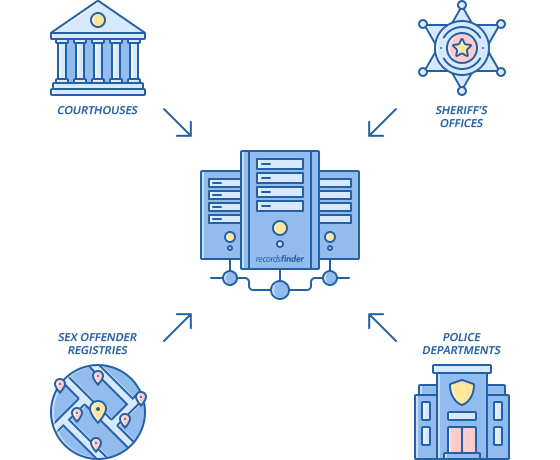
Police records are typically used to track criminal activities and provide details about individuals' interactions with the justice system. These records are generally created by government officials and maintained by local, state, or federal police departments. Portions of these records may be available to the public, depending on state laws and the nature of the cases.
The main purposes of police records are to document facts, support investigations or legal actions, and promote transparency. Whether used in courts, reviewed by insurance companies, or requested by individuals, these records usually play important roles in law enforcement processes.
It is important to understand that police records are not the same as arrest records or court records:
- Police Records - These document law enforcement activity, including reports that may or may not lead to arrests.
- Arrest Records - These specifically list instances where individuals have been taken into custody.
- Court Records - These begin once charges are filed and may include the legal proceedings that follow arrests or citations.
Police Records Resources
- Animal Cruelty
- Arson
- Assault
- Burglary
- Check Fraud
- Child Pornography
- Controlled Substances
- Copyright Infringement
- Fraud
- Grand Theft
- Illegal Drugs Possession
- Kidnapping
- Manslaughter
- Murder
- Obstruction of Justice
- Perjury
- Probation Violation
- Sexual Assault
- Tax Evasion
- Theft
- Threatening Government
- Treason
- Vandalism
- Vehicular Homicide
- Wire and Mail Fraud
How To Find Police Public Records
Police records searches may be conducted through RecordsFinder.com, as well as through official sources by mail or in-person requests at the relevant law enforcement agencies.
Search Police Records Online
RecordsFinder provides a convenient way to perform a police record check online without visiting a police department. This user-friendly platform generally allows individuals to conduct a police report search by entering a name and refining results by location. Whether you're seeking arrest histories, incident reports, or general police activity, RecordsFinder is typically one of the accessible tools available for reviewing police records online for both personal and professional use.
Request Police Reports in Person or by Mail
To conduct a police report lookup, individuals may request records from local police departments, sheriff's offices, or court clerks. Requests can typically be made in person or by mail, using official forms that require details like the incident date, location, and names involved. Processing times and fees vary by agency, and some may charge for copies or administrative handling.
Before beginning a police report search, it's generally advisable to check the agency's website or contact their records division for guidelines, accepted payments, and any applicable access limitations.
Find Police Records by State
When searching for official documentation of arrests, incidents, or investigations, accessing state police records may be a crucial step. Each state manages these records differently, so understanding how to find a state police report online or conduct a state police record check generally ensures a smoother and more accurate search process.
- Alabama
- Alaska
- Arizona
- Arkansas
- California
- Colorado
- Connecticut
- Delaware
- District of Columbia
- Florida
- Georgia
- Hawaii
- Idaho
- Illinois
- Indiana
- Iowa
- Kansas
- Kentucky
- Louisiana
- Maine
- Maryland
- Massachusetts
- Michigan
- Minnesota
- Mississippi
- Missouri
- Montana
- Nebraska
- Nevada
- New Hampshire
- New Jersey
- New Mexico
- New York
- North Carolina
- North Dakota
- Ohio
- Oklahoma
- Oregon
- Pennsylvania
- Rhode Island
- South Carolina
- South Dakota
- Tennessee
- Texas
- Utah
- Vermont
- Virginia
- Washington
- West Virginia
- Wisconsin
- Wyoming
Are Police Reports Public Records?
Police reports are typically classified as public police records, meaning they may be accessed by the public under most state laws. However, access may be restricted or redacted in cases involving minors, ongoing investigations, or sensitive personal information. While police records are generally available, each state sets its own rules regarding what may be released and how. To access a report, requesters may need to follow formal steps, show valid ID, and pay any required fees.
FAQs About Police Records
Does an accident go on your record if no police report is filed?
Accidents may still appear on driving records even when police reports are not filed, especially if insurance claims are submitted. Insurance companies often report incidents to state databases, which may impact driving records.
How to find police records for free?
Some basic police records may be available at no cost through public records sites or local agencies, but full or detailed reports typically involve a processing fee from authorized sources.
Why is part of a police report redacted?
Redactions in police reports are generally made to protect sensitive information—such as the identities of minors, victims' privacy, ongoing investigations, or to comply with state and federal privacy laws.
Can I access someone else's police report?
In many cases, yes, but with certain limitations. While police reports are generally considered public records, access to third-party reports may be restricted if they contain sensitive or private information or if such reports are sealed.
How to find police disciplinary records
Police disciplinary records may be obtained by submitting public records requests to law enforcement agencies or oversight boards, though access depends on state laws—some mandate disclosure, while others impose restrictions.
How to get police records for immigration
For immigration purposes, individuals may be required to submit certified copies of police reports or checks. These may be requested from the relevant police departments or courts.
Why Choose RecordsFinder.com?

Fast
Search over 2 billion records instantly. Easily find the information you are looking for with three easy steps- search, sign up, and view report.

Comprehensive
We have one of the most comprehensive data coverages in the industry including state, federal, county, municipal, and private data sources when available.

Affordable
With our unlimited search access, you can look up as many reports as you want! Others charge for every single search.

Reliable
Millions of users rely on us to deliver accurate and current data for their information needs.
Search Police Records on RecordsFinder.com
Recordsfinder.com is not a consumer reporting agency as defined by the Fair Credit Reporting Act (FCRA), and does not assemble or evaluate information for the purpose of supplying consumer reports.
You understand that by clicking "I Agree" you consent to our Terms of Service and Privacy Policy and agree not to use information provided by Recordsfinder.com for any purpose under the FCRA, including to make determinations regarding an individual's eligibility for personal credit, insurance, employment, tenant screening, or for any other purpose governed by the FCRA, and you agree to indemnify Recordsfinder.com from any 3rd party claims, complaints, or actions arising from your violation of the Terms.
This website contains information collected from public and private resources. Recordsfinder.com cannot confirm that information provided below is accurate or complete. Please use information provided by Recordsfinder.com responsibly.
You further authorize Recordsfinder.com to conduct a search to identify preliminary results of records related to the subject you entered. The first search we conduct is a people search to locate and identify the person whose name(s) match the search term(s) you entered. The people search does not search court, criminal, or official records. You understand and agree that full search reports will only be available after you register for an account or purchase a report.