
Bankruptcy Records Search
Bankruptcies, Liens, Judgments, Lawsuits, Assets & More!
What customers are saying
"I called to cancel my account and the young man that helped me was very nice and helpful"
"The agent was wonderful. She explained everything to me in detail. Thank you!"
"Tom was able to look up my account and resolve my issue with great professionalism! Thank yoi"
"They were very helpful. Answered all my questions and solved my issue."
"Excellent customer service, I had my concerns addressed immediately without any problems."
"Great help, Patient and honest. My customer care was clear about everything."
"records were very clear and easy to search."
"The service was excellent handled everything I needed to be handled perfect i would recommend it"
"A top class act in customer service."
"I had been researching for a lost information on a vehicle for over a month. Ran into brick walls everywhere. Record Finder did the job for me. Thank you so much."
"The rep was very helpful and the information was great. Thanks"
"Exceptional customer service and outstanding site! I highly recommend!"
"They helped me find the information I needed."
"Excellent service with great ease of use. Very courteous and professional customer service as well."
"The lady who help me was very professional and helpful. She was able to find a solution to my issue I really appreciate her time."
"Customer service went the extra mile for me to correct a problem on my account and I am so very grateful."
"I worked with a wonderful woman named Rhea who was patient and understanding of my situation. If I am ever in need of your services again, I will not hesitate to use them."
"I am confident that Records Finder will be able to provide contact info on a missing person I wish to contact. I have used Records Finder several times in the past and usually with success. I recommend their services."
"I used Record Finder to find info on me. I really understand how important good info can be."
"The process was simple and straight forward. Accurate base on history and informative. Customer service representative was courteous and friendly."
"I had no problem with Record Finder and they helped me find the person I was looking for."
"BAM! Was able to find the owner of a vehicle!"
"Everything worked great! It was easy to use and operate! My on line chat person was awesome!"
"I was helped swiftly and accurately. The rep was courteous and respectful, and saw to my need immediately. Great Job!!"
"This is a very helpful site. I was able to access the site with ease and find the information I needed quickly and completely."

What Information is Available in Bankruptcy Reports?
Whether you are looking to assess financial risk, conduct due diligence, or are simply curious about your financial history, bankruptcy records may often offer insights into a person’s or business’s financial history. But what exactly do these records generally include, and how might you access them?

Bankruptcy Filings
Find all types of bankruptcy filings within seconds. Learn about the financial misfortunes of any individual by gaining access to millions of bankruptcy court records throughout the country without visiting a courthouse. Do it faster & easier, online.

Judgments
Access all previous and latest judgements that involve someone you know. By performing a completely anonymous search within out database, you'll be able to know about their criminal convictions, penalties, fines, civil lawsuits and more.

Liens
Look up an individual'sfull Lien Records, such as Property Liens, Vehicle Liens, Mechanic Liens, Personal Liens, Attorney Liens or Tax Liens. Our online search tool is the best way to verify if a property is subject to a lien or check for unpaid taxes.

Assets
For years we've been compiling the most accurate assets data on anyone. Discover the ultimate online lookup took for tangible or intangible assets tracking, including land, personal property, financial investments, money in the bank orsavings.

Lawsuits
By combing through millions of lawsuit records, we provide the best search results whenever you want to thoroughly check bankruptcy case information, financial details, case summaries, court location, hearing dates, filing details and much more.

Criminal Records
Occasionally, bankruptcies are linked to criminal convictions, therefore, our report may also divulge court orders, if someone was found guilty of a bankruptcy offense, if they were fined or incarcerated, if they attempted to fraud, destruct or falsify financial records.
What are Bankruptcy Records?
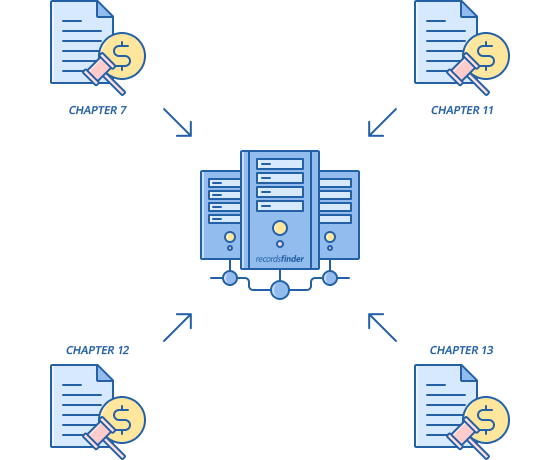
Bankruptcy records are official court documents that provide a detailed account of bankruptcy proceedings filed in U.S. federal bankruptcy courts. These records offer insight into a debtor’s financial situation, legal obligations, and the outcome of the bankruptcy case.
These records are part of the public domain unless sealed by court order, ensuring transparency and accountability in the legal process.
Public bankruptcy records typically include the debtor’s name, filing date, case number, court jurisdiction, and type of bankruptcy, such as Chapter 7 (liquidation), Chapter 13 (repayment plan), or Chapter 11 (business reorganization). They also contain
- Schedules of assets and liabilities,
- A creditor matrix listing all parties owed money,
- Income and expense statements, and
- Means test results for Chapter 7 eligibility (when applicable).
Note that Chapter 13 filings often include court-approved repayment plans outlining how debts will be settled over time. Additional documents may include motions, court orders, trustee reports, and status updates, offering a comprehensive view of each case.
How To Get Bankruptcy Records
If you are wondering where you can look up bankruptcies online or how to get bankruptcy records without the hassle, the official source is PACER. The federal court system's database provides access to bankruptcy cases but requires registration and charges per document.
Alternatively, you may try RecordsFinder.com, a more convenient search tool for finding bankruptcy reports by name and location. While not affiliated with the federal courts, RecordsFinder aggregates public data, offering quick, user-friendly access to check for bankruptcy filings without needing legal expertise.
Bankruptcy Records by States
While states like Vermont and Rhode Island have only one federal district, more populous states like California and New York are divided into multiple federal districts. Hence, a successful search of state bankruptcy reports begins with identifying the relevant U.S. Bankruptcy Court district where such records are filed, usually based on the debtor's business location. Once located, you can find bankruptcy records by state through the appropriate court's portal, though access and search tools may vary by district.
- Alabama
- Alaska
- Arizona
- Arkansas
- California
- Colorado
- Connecticut
- Delaware
- District of Columbia
- Florida
- Georgia
- Hawaii
- Idaho
- Illinois
- Indiana
- Iowa
- Kansas
- Kentucky
- Louisiana
- Maine
- Maryland
- Massachusetts
- Michigan
- Minnesota
- Mississippi
- Missouri
- Montana
- Nebraska
- Nevada
- New Hampshire
- New Jersey
- New Mexico
- New York
- North Carolina
- North Dakota
- Ohio
- Oklahoma
- Oregon
- Pennsylvania
- Rhode Island
- South Carolina
- South Dakota
- Tennessee
- Texas
- Utah
- Vermont
- Virginia
- Washington
- West Virginia
- Wisconsin
- Wyoming
Who Might Use Bankruptcy Records and Why
Bankruptcy records are a valuable source of legal and financial insight used by various individuals and organizations for different purposes.
- Lenders and financial institutions review these records to assess a borrower's creditworthiness during loan or refinancing evaluations.
- Employers, particularly in finance or security-related fields, may include a bankruptcy records search in history checks for roles involving fiduciary duties.
- Landlords and property managers use them to evaluate a tenant's financial stability.
- Attorneys, trustees, and debt collectors rely on bankruptcy filings to verify debt status, creditor claims, or whether an automatic stay or discharge applies.
- Journalists, researchers, and individuals may explore bankruptcy records for reporting, academic analysis, or personal interest.
FAQs About Bankruptcy Records
How to find bankruptcy records for free?
Interested persons may only be able to access bankruptcy records for free by visiting the public terminals at federal courts or online via PACER; if they are a party to the case. For a quick, low-cost bankruptcy records search, RecordsFinder offers an easy way to check bankruptcy filings by name and location.
How long does bankruptcy stay on your credit report?
The length of time bankruptcy stays on your credit report depends on the type, Chapter 7 remains for 10 years, while Chapter 13 typically lasts 7 years, after which it is automatically removed by credit bureaus.
Are bankruptcy records public?
Generally, bankruptcy records are accessible to the public, except that they are sealed by the court. However, personal information like full Social Security numbers and financial account details is redacted to protect privacy.
How can I find out if my bankruptcy case is closed?
To check if your bankruptcy case is closed, you can log into PACER, call the free VCIS phone system, contact the bankruptcy court clerk, or use RecordsFinder.com to see if your case is listed as closed in public records.
Can I get proof I never filed for bankruptcy?
To confirm no bankruptcy case has been filed under your name or Social Security number, you can request a “no record” certificate from the Bankruptcy Court or perform a comprehensive search through PACER or a third-party provider.
Is it legal to search someone’s bankruptcy record?
It is legal to search someone’s bankruptcy record as they are public documents, but any use must comply with laws like the Fair Credit Reporting Act, which requires proper disclosure and consent.
Why Choose RecordsFinder.com?

Fast
Search over 2 billion records instantly. Easily find the information you are looking for with three easy steps- search, sign up, and view report.

Comprehensive
We have one of the most comprehensive data coverages in the industry including state, federal, county, municipal, and private data sources when available.

Affordable
With our unlimited search access, you can look up as many reports as you want! Others charge for every single search.

Reliable
Millions of users rely on us to deliver accurate and current data for their information needs.
Search Bankruptcy Records on RecordsFinder.com
Recordsfinder.com is not a consumer reporting agency as defined by the Fair Credit Reporting Act (FCRA), and does not assemble or evaluate information for the purpose of supplying consumer reports.
You understand that by clicking "I Agree" you consent to our Terms of Service and Privacy Policy and agree not to use information provided by Recordsfinder.com for any purpose under the FCRA, including to make determinations regarding an individual's eligibility for personal credit, insurance, employment, tenant screening, or for any other purpose governed by the FCRA, and you agree to indemnify Recordsfinder.com from any 3rd party claims, complaints, or actions arising from your violation of the Terms.
This website contains information collected from public and private resources. Recordsfinder.com cannot confirm that information provided below is accurate or complete. Please use information provided by Recordsfinder.com responsibly.
You further authorize Recordsfinder.com to conduct a search to identify preliminary results of records related to the subject you entered. The first search we conduct is a people search to locate and identify the person whose name(s) match the search term(s) you entered. The people search does not search court, criminal, or official records. You understand and agree that full search reports will only be available after you register for an account or purchase a report.