
Assets & Unclaimed Property Search
Unclaimed Property, Unclaimed Assets, Unclaimed Funds, Unclaimed Cash & More!
What customers are saying
"I called to cancel my account and the young man that helped me was very nice and helpful"
"The agent was wonderful. She explained everything to me in detail. Thank you!"
"Tom was able to look up my account and resolve my issue with great professionalism! Thank yoi"
"They were very helpful. Answered all my questions and solved my issue."
"Excellent customer service, I had my concerns addressed immediately without any problems."
"Great help, Patient and honest. My customer care was clear about everything."
"records were very clear and easy to search."
"The service was excellent handled everything I needed to be handled perfect i would recommend it"
"A top class act in customer service."
"I had been researching for a lost information on a vehicle for over a month. Ran into brick walls everywhere. Record Finder did the job for me. Thank you so much."
"The rep was very helpful and the information was great. Thanks"
"Exceptional customer service and outstanding site! I highly recommend!"
"They helped me find the information I needed."
"Excellent service with great ease of use. Very courteous and professional customer service as well."
"The lady who help me was very professional and helpful. She was able to find a solution to my issue I really appreciate her time."
"Customer service went the extra mile for me to correct a problem on my account and I am so very grateful."
"I worked with a wonderful woman named Rhea who was patient and understanding of my situation. If I am ever in need of your services again, I will not hesitate to use them."
"I am confident that Records Finder will be able to provide contact info on a missing person I wish to contact. I have used Records Finder several times in the past and usually with success. I recommend their services."
"I used Record Finder to find info on me. I really understand how important good info can be."
"The process was simple and straight forward. Accurate base on history and informative. Customer service representative was courteous and friendly."
"I had no problem with Record Finder and they helped me find the person I was looking for."
"BAM! Was able to find the owner of a vehicle!"
"Everything worked great! It was easy to use and operate! My on line chat person was awesome!"
"I was helped swiftly and accurately. The rep was courteous and respectful, and saw to my need immediately. Great Job!!"
"This is a very helpful site. I was able to access the site with ease and find the information I needed quickly and completely."

What Information is Available in Unclaimed Reports?
Unclaimed property reports may reveal a wide range of forgotten or unknown assets, including life insurance benefits, inheritance funds, savings accounts, and government checks. Other commonly unclaimed assets may include investments, retirement accounts, wages, and royalties, often overlooked due to outdated information or a lack of awareness.

Life Insurance & Inheritance
Find out if you are the rightful owner of any dormant, forgotten or abandoned assets. Discover unclaimed Life Insurance, Missing Inheritance and class action settlements that await your action. Do it in a few seconds, by using our lookup tool.

Savings
Due to sudden death, name change after marriage or divorce, incomplete or illegible records or an unreported change of residence, forgotten MoneyOrders, Bank Accountsand Uncashed Checks could await your claim. Find out today with a quick search.

Investments
Unclaimed US stocks and bonds shared by nationwide databases, banks andstockbrokers could enhance your income as soon as you discover more about them. Use our search to get all the information you need in just a few seconds.

Retirement Accounts & Pensions
Large numbers of owners or heirs - who may not be aware of a deceased family member IRA or rollover 401k – fail to claim funds to which they are entitled. Know all the details from a quick online report with our lookup tool, easy to use from any device.

Government Checks
IRS Tax Refunds, Social Security Benefits, Child Support, HUD Refunds – they could all reach your account as long as you initiate a search first. Government agencies make little effort to find missing beneficiaries and you must take the lead.

Wages & Royalties
Forgotten Wages, Rebate Checks, Author Royalties, Musician Royalties, Gift Card Refunds, Mineral Royalties, Screen Actor Residuals and more are awaiting their owners. Get to know the amounts and if you are entitled to any claims.
What Are Unclaimed Property Records?
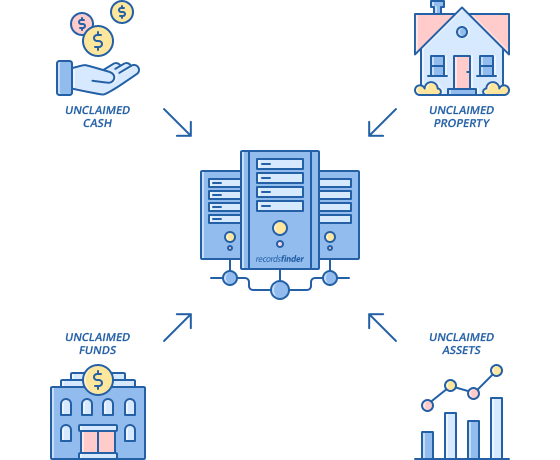
It is not uncommon for even well-informed persons to ask, "What is unclaimed property?" Unclaimed property generally refers to financial assets, such as cash, accounts, or investments, that show no activity or contact with the owner over a set period. Once deemed inactive, unclaimed property is typically handed over to the state for safekeeping until claimed.
Businesses, banks, insurance companies, or government agencies typically record such assets when they transfer them to the state. These official reports are called Unclaimed Property Records. The records are maintained by each state's unclaimed property office to help rightful owners recover their unclaimed money or assets.
A typical record may include the owner's name, last known address, amount of money, type of property (e.g., savings, dividends, life insurance payouts), and the holding institution's name. In some cases, account or policy numbers may be listed to aid in verifying ownership. Financial assets that may be called unclaimed money or property include:
- Forgotten savings accounts
- Life insurance payouts
- Uncashed checks
- Refunds
- Dividends
- Trust funds
- Escrow accounts
- Stocks
- Mutual bonds
- Matured or terminated insurance policies
- Estates
States generally maintain these searchable databases to help people reclaim forgotten funds. Millions in unclaimed money may go undiscovered each year, often just waiting for a search.
How To Find Unclaimed Money Online?
If you suspect you may have unclaimed money or property, you can use RecordsFinder.com to locate it. Unlike some government websites that typically require multiple steps or searches across different state databases, RecordsFinder offers a faster way to perform a search for unclaimed money in one place.
On the RecordsFinder search tool, enter your full name and city of residence to begin a search. Upon submitting the information, the system generally performs a database search to see if the provided information matches the stored information associated with unclaimed property records sourced from multiple public record databases.
The results from the search will typically show details such as
- Your name or a close match,
- The type of property or funds reported,
- The last known address associated with the account,
- The state currently holding the unclaimed money,
- And the name of the company or agency that reported the funds may also appear.
Searching for unclaimed assets through our website may help users quickly locate potential unclaimed money from home, especially if they've moved between states or want to avoid searching individual state websites. While there may be a fee for detailed reports, the process is generally quicker and more convenient than conducting multiple manual searches.
Who Can Claim Unclaimed Property and Why It Matters?
If you've ever wondered whether there may be unclaimed money in your name, now is the time to find out. Unclaimed property may generally be claimed by the original owner, legal heirs, or authorized representatives, and it often includes:
- Forgotten retirement accounts,
- Old savings,
- Uncashed checks,
- IRS refunds, or
- Funds from a deceased relative's estate.
Whether you're tracking down a lost security deposit or a life insurance benefit, searching for unclaimed property may help you discover what could rightfully belong to you. Many people overlook assets tied to past jobs, closed accounts, or inheritance simply because they're unaware that those funds exist.
With our tool, you may quickly find possible unclaimed money by entering your name and state of residence; usually, no legal expertise or complex paperwork is needed. It's generally faster and more convenient than searching through multiple government sites individually.
Taking a few minutes to search may help you identify money or property you didn't know about, protecting your finances and bringing long-lost assets back into your hands.
FAQs About Unclaimed Assets
What types of assets qualify as unclaimed property?
Common examples of assets that qualify as unclaimed property include dormant bank accounts, mineral interests and royalty payments, stocks, bonds, dividends, mutual funds, bank accounts, safe deposit box contents, certificates of deposits, trust funds, escrow accounts, utility account deposits, matured or terminated insurance policies, and estates.
How to find unclaimed money for free?
You may use RecordsFinders to find free details online about unclaimed money.
Is unclaimed property really public?
Once property is turned over to the state, it becomes part of a public database. Therefore, anyone may search for unclaimed property records using the owner's name.
How often is unclaimed money updated in online databases?
Most state databases update their unclaimed property records at least once a year. However, some states update more frequently, monthly or quarterly, depending on reporting requirements and internal schedules.
How do I find unclaimed money in my name?
To find unclaimed money in your name, visit an official unclaimed property search site or search for such details on RecordsFinder.
How long does the state keep unclaimed property?
While the dormancy period is generally no more than five years, states typically hold unclaimed property indefinitely. However, there is no expiration date for claiming such property. Regardless, you or your heirs may file a claim anytime to reclaim the property.
Why Choose RecordsFinder.com?

Fast
Search over 2 billion records instantly. Easily find the information you are looking for with three easy steps- search, sign up, and view report.

Comprehensive
We have one of the most comprehensive data coverages in the industry including state, federal, county, municipal, and private data sources when available.

Affordable
With our unlimited search access, you can look up as many reports as you want! Others charge for every single search.

Reliable
Millions of users rely on us to deliver accurate and current data for their information needs.
Search Unclaimed Money on RecordsFinder.com
Recordsfinder.com is not a consumer reporting agency as defined by the Fair Credit Reporting Act (FCRA), and does not assemble or evaluate information for the purpose of supplying consumer reports.
You understand that by clicking "I Agree" you consent to our Terms of Service and Privacy Policy and agree not to use information provided by Recordsfinder.com for any purpose under the FCRA, including to make determinations regarding an individual's eligibility for personal credit, insurance, employment, tenant screening, or for any other purpose governed by the FCRA, and you agree to indemnify Recordsfinder.com from any 3rd party claims, complaints, or actions arising from your violation of the Terms.
This website contains information collected from public and private resources. Recordsfinder.com cannot confirm that information provided below is accurate or complete. Please use information provided by Recordsfinder.com responsibly.
You further authorize Recordsfinder.com to conduct a search to identify preliminary results of records related to the subject you entered. The first search we conduct is a people search to locate and identify the person whose name(s) match the search term(s) you entered. The people search does not search court, criminal, or official records. You understand and agree that full search reports will only be available after you register for an account or purchase a report.