
Court Records Search
Criminal Records, Bankruptcies, Liens, Judgments, Lawsuits, Warrants & More!
What customers are saying
"I called to cancel my account and the young man that helped me was very nice and helpful"
"The agent was wonderful. She explained everything to me in detail. Thank you!"
"Tom was able to look up my account and resolve my issue with great professionalism! Thank yoi"
"They were very helpful. Answered all my questions and solved my issue."
"Excellent customer service, I had my concerns addressed immediately without any problems."
"Great help, Patient and honest. My customer care was clear about everything."
"records were very clear and easy to search."
"The service was excellent handled everything I needed to be handled perfect i would recommend it"
"A top class act in customer service."
"I had been researching for a lost information on a vehicle for over a month. Ran into brick walls everywhere. Record Finder did the job for me. Thank you so much."
"The rep was very helpful and the information was great. Thanks"
"Exceptional customer service and outstanding site! I highly recommend!"
"They helped me find the information I needed."
"Excellent service with great ease of use. Very courteous and professional customer service as well."
"The lady who help me was very professional and helpful. She was able to find a solution to my issue I really appreciate her time."
"Customer service went the extra mile for me to correct a problem on my account and I am so very grateful."
"I worked with a wonderful woman named Rhea who was patient and understanding of my situation. If I am ever in need of your services again, I will not hesitate to use them."
"I am confident that Records Finder will be able to provide contact info on a missing person I wish to contact. I have used Records Finder several times in the past and usually with success. I recommend their services."
"I used Record Finder to find info on me. I really understand how important good info can be."
"The process was simple and straight forward. Accurate base on history and informative. Customer service representative was courteous and friendly."
"I had no problem with Record Finder and they helped me find the person I was looking for."
"BAM! Was able to find the owner of a vehicle!"
"Everything worked great! It was easy to use and operate! My on line chat person was awesome!"
"I was helped swiftly and accurately. The rep was courteous and respectful, and saw to my need immediately. Great Job!!"
"This is a very helpful site. I was able to access the site with ease and find the information I needed quickly and completely."

What Information is Available in Court Reports?
Court records offer valuable insight into legal proceedings. While many of these records are publicly accessible under open justice laws, the content, availability, and level of access vary depending on the case type and jurisdiction. Below, we break down what's included in these reports, how to find them, and which types of court case information remain confidential.

Criminal Case Records
If you are interested in accessing over 1 billion criminal case records from federal, state, country and local authorities, our online lookup tool is your quickest and most efficient option. You will be able to locate convicts, explore their criminal past or see their mug shots in no time.

Civil Case Records
Looking for information on a civil case? Instead of visiting the County Clerk & District Clerk, you can instantly search for civil court case records right from your internet browser. Get to know the Case, Name, Court, Date, Case Status, Description, Person Type and more details.

Evictions
Interested in knowing if someone you know has ever been evicted from any of the places where they resided? You're in the right place! Use our website's search option to uncover the basic eviction data you need about your subject of interest within seconds.

Traffic Violations
Find out if the person is a habitual offender or not. Search for Driving License Suspensions, Fines, Penalties, Vehicular Assault Charges, Speeding Tickets, Hit and Run, Dangerous Driving Convictions, DUI or DWI Arrests and Jail Timeand more traffic offenses.

Warrants
We systematically check for Arrest Warrants, Outstanding Warrants, Surety Warrants, and Bench Warrants issued by any federal, state, county or local courts in the US. With our lookup tool, you're getting direct access 24/7 to all this data right from your internet browser.

Lawsuits
Discover Contract Disputes, Liens, Judgments, Criminal or Civil Lawsuits, among a person's history of legal actions, online, with just a click of a mouse. Be informed of the latest legal matters regarding someone you're interested in, at any time. We make it quick & simple.
What Are Public Court Records?
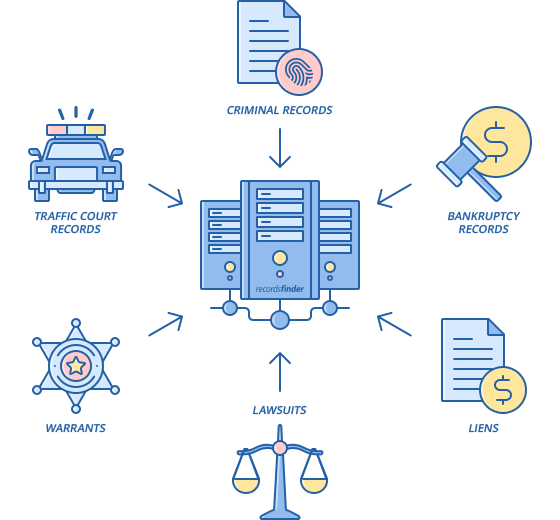
Court records are official documents created and maintained by the judicial system during legal proceedings, and many are available as public court records under open access laws. These records span civil, criminal, family, probate, and administrative cases, offering detailed court case information. A typical court report includes
- Names of involved parties (plaintiff, defendant, victim),
- Case number,
- Filing date,
- Court location, and
- A docket listing all actions, such as motions, hearings, and rulings.
These reports may also contain arrest data, charges, bail terms, and sentencing outcomes, while civil files often include complaints, responses, motions, and settlement details. Supporting materials like affidavits, subpoenas, summonses, and transcripts may also be included. Public access court records can be viewed at courthouse terminals, through local or state court websites, or via PACER for federal cases.
How To Find Court Records Online
Accessing court records today is quicker and more convenient than ever with RecordsFinder.com. In the past, searching court records required visiting courthouses, filling out request forms, and sometimes paying fees for physical copies.
Now, some court clerks provide online access to files of cases heard in their local courts. Interested users may search available case information by name, case number, or filing date through the official website of the local court. However, navigating multiple court websites can become tedious and overwhelming, especially when cases span multiple jurisdictions.
RecordsFinder simplifies the process by aggregating court records from local, state, and federal databases into one easy-to-use platform. Users can start with a free court records search, which often provides basic court case information such as case type, status, and involved parties. Full court reports may require a fee, but the platform's convenience and time-saving features make it a valuable tool for court records searches.
Court Case Lookup by States
To find court records by state, users need to explore the relevant state's unique judicial system, which may include trial, appellate, and supreme courts with varying levels of public access. A successful state court record search depends on understanding how state court records are organized, whether through a centralized portal or local county clerk systems.
- Alabama
- Alaska
- Arizona
- Arkansas
- California
- Colorado
- Connecticut
- Delaware
- Florida
- Georgia
- Hawaii
- Idaho
- Illinois
- Indiana
- Iowa
- Kansas
- Kentucky
- Louisiana
- Maine
- Maryland
- Massachusetts
- Michigan
- Minnesota
- Mississippi
- Missouri
- Montana
- Nebraska
- Nevada
- New Hampshire
- New Jersey
- New Mexico
- New York
- North Carolina
- North Dakota
- Ohio
- Oklahoma
- Oregon
- Pennsylvania
- Rhode Island
- South Carolina
- South Dakota
- Tennessee
- Texas
- Utah
- Vermont
- Virginia
- Washington
- West Virginia
- Wisconsin
- Wyoming
What Types of Court Case Information Are Restricted or Confidential?
While most court records in the U.S. are public, some court case information is confidential or sealed by law to protect privacy or uphold justice. Public court records generally include civil, criminal, and traffic cases, but sensitive matters, like juvenile cases, mental health proceedings, and adoption records, are typically restricted. For example, juvenile court records involving delinquency or child welfare are sealed to safeguard a minor's future.
Similarly, mental health evaluations, involuntary commitments, and adoption or guardianship cases are confidential under both court rules and federal privacy laws like HIPAA. Family court matters involving custody, domestic violence, or sensitive financial data may also be partially or fully restricted.
In criminal cases, court records related to expungements, sexual assault victims, confidential informants, or national security issues are commonly sealed. Grand jury proceedings and investigative documents are likewise closed to protect due process. While public court records offer transparency, access depends on the nature of the case and applicable privacy laws governing specific court case information.
FAQs About Court Records
How to find court records online for free
You can search basic court records for free through the official website of the court where the case was filed, as many states provide public portals with name or case number search tools. For quicker access, RecordsFinder.com offers a free initial court records search across federal, state, and local databases, with basic details like case status and involved parties.
What is included in a civil court case File?
A civil court case file generally includes the complaint, defendant's response, motions, court orders, and final judgment, along with possible exhibits, transcripts, affidavits, and notices, though the contents vary by jurisdiction and case complexity.
How do I get a copy of the court transcripts?
To obtain a court transcript, contact the clerk's office where the case was heard. Transcripts, prepared by official court reporters, typically require a written request and a per-page fee and may be available online depending on the court's policies.
Can I access sealed court records?
Sealed records are not available to the public. Access is limited to parties involved in the case or by court order. If you believe you have a legal right to view sealed information, you must petition the court and show just cause for access.
How long are court records kept?
Court record retention periods vary by jurisdiction and case type. Criminal and civil records may be preserved indefinitely, while lesser matters like traffic violations or administrative cases may be destroyed after 5 to 10 years.
How to remove a court case from the public record
Removing a court case from public access generally requires a petition for expungement or record sealing. Eligibility depends on state law, the nature of the case, and the final outcome. The process may include court filings and a hearing. Not all records qualify for removal.
Why Choose RecordsFinder.com?

Fast
Search over 2 billion records instantly. Easily find the information you are looking for with three easy steps- search, sign up, and view report.

Comprehensive
We have one of the most comprehensive data coverages in the industry including state, federal, county, municipal, and private data sources when available.

Affordable
With our unlimited search access, you can look up as many reports as you want! Others charge for every single search.

Reliable
Millions of users rely on us to deliver accurate and current data for their information needs.
Search Court Records on RecordsFinder.com
The information on this website is taken from records made available by state and local law enforcement departments, courts, city and town halls, and other public and private sources. You may be shocked by the information found in your search reports. Please search responsibly.
Recordsfinder.com is not a “consumer reporting agency” and does not supply “consumer reports” as those terms are defined by the Fair Credit Reporting Act (FCRA). Pursuant to our Terms of Service and Privacy Policy, you acknowledge and agree not to use any information gathered through Recordsfinder.com for any purpose under the FCRA, including but not limited to evaluating eligibility for personal credit, insurance, employment, or tenancy.
Searches of license plate and VIN information are available only for purposes authorized by the Driver’s Privacy Protection Act of 1994 (DPPA).
By clicking “I Agree” you consent to our Terms of Service, agree not to use the information provided by Recordsfinder.com for any unlawful purposes, and you understand that we cannot confirm that information provided below is accurate or complete.
The search you are about to conduct on this website is a people search to find initial results of the search subject. You understand that any search reports offered from this website will only be generated with the purchase of the report or account registration.